

Intro
The Comparative Similarity (CSMOS) evaluation is designed to assess which of two audio samples is more similar to a reference audio. This evaluation is particularly useful in scenarios where the goal is to match or mimic a reference audio, such as in voice cloning or audio restoration tasks.- Objective: Determine the similarity of two audio samples to a reference audio.
- Use Case: Ideal for applications requiring audio matching or quality assessment against a standard.
- Type:
CSMOSin the SDK.
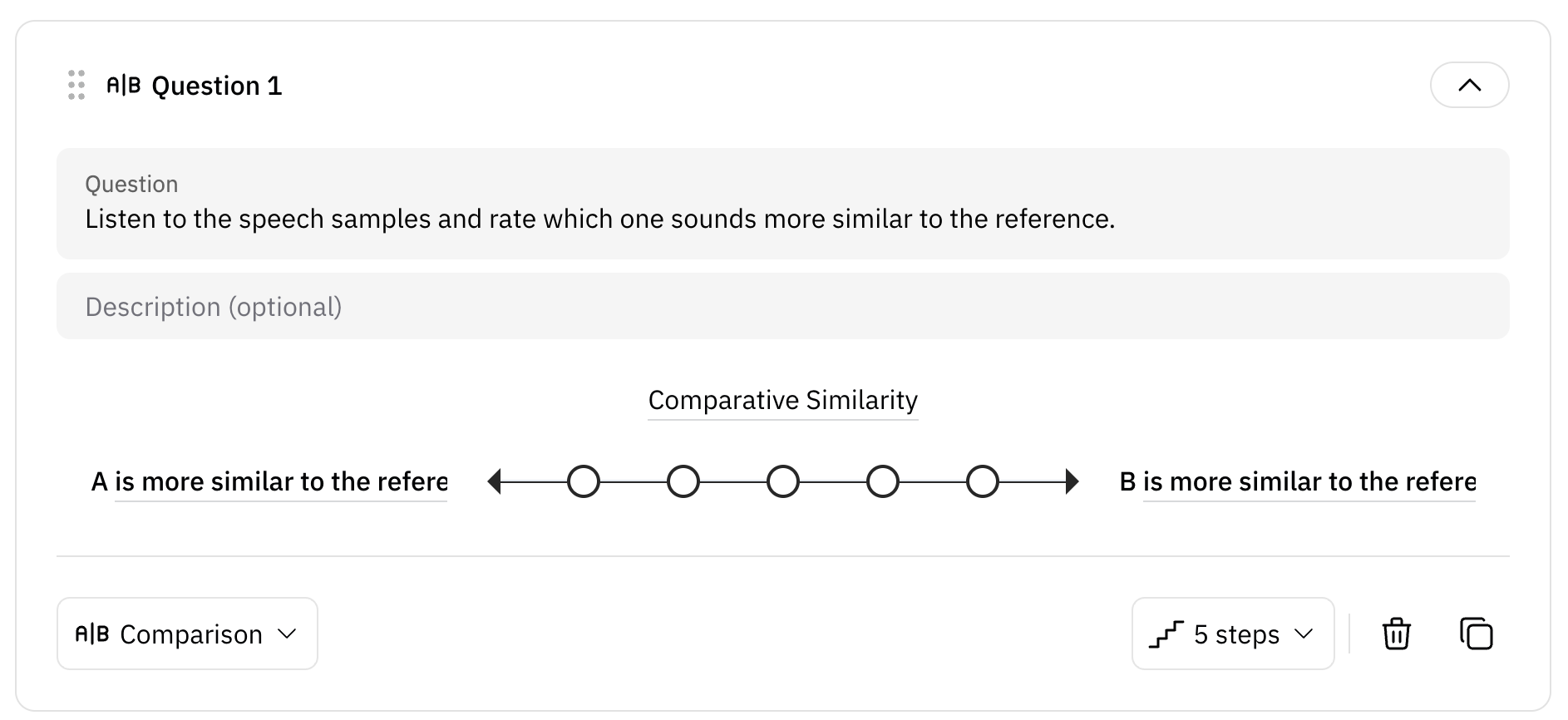
Example
1
Initialize the Client
Begin by initializing the Podonos client with your API key.
2
Create the Evaluator
Set up the evaluator for a CSMOS evaluation.
3
Add Files for Evaluation
Add two audio samples and one reference audio. The reference file must be specified with
is_ref=True.- File Order: Ensure the reference file is the third file in the
add_filesmethod. The two samples can be passed in either order — the SDK sorts them bymodel_tagso each keeps the same position across every group. Do not shuffle them yourself; presentation order is randomized per evaluator. See Bias Minimization.
4
Finalize the Evaluation
Close the evaluator to complete the setup.
Key Considerations
- File Configuration: The reference file must be clearly marked with
is_ref=Trueand should be the last file in theadd_filesmethod. - Evaluation Logic: The CSMOS evaluation logic will compare the two audio samples against the reference to determine which is more similar.
- Applications: Useful for tasks like voice cloning, audio restoration, and quality assurance where matching a reference is critical.