Beyond English: Expanding TTS Evaluation into Multi-languages

Many voice AI teams perfect their models in English first. But what happens when the model expands to global markets? The truth is, performance doesn’t always translate—literally. 

Why Multilingual Evaluation Matters:

Voice models often perform well in one language but fail to maintain its naturalness, fluency, and quality across others. Issues like intonation, accent accuracy, and unnatural pauses become more apparent in languages with distinct phonetic systems. A model that sounds smooth in English might sound robotic in Mandarin, or overly accented in Spanish.

What Podonos Offers:

With our multilingual evaluation support, you can now:

Real-World Application:

We’ve seen growing demand from teams preparing product launches in multilingual markets. For example, if you're expanding your voice assistant or TTS model to regions like Japan, China, or Latin America, Podonos enables you to test language-specific issues early—before they reach end users.

Getting Started:

If your model is heading beyond your language, we'll help ensure it sounds just as natural—wherever it's heard. You can extend your current evaluation template or create a new multilingual benchmark directly from your workspace.
Other readings

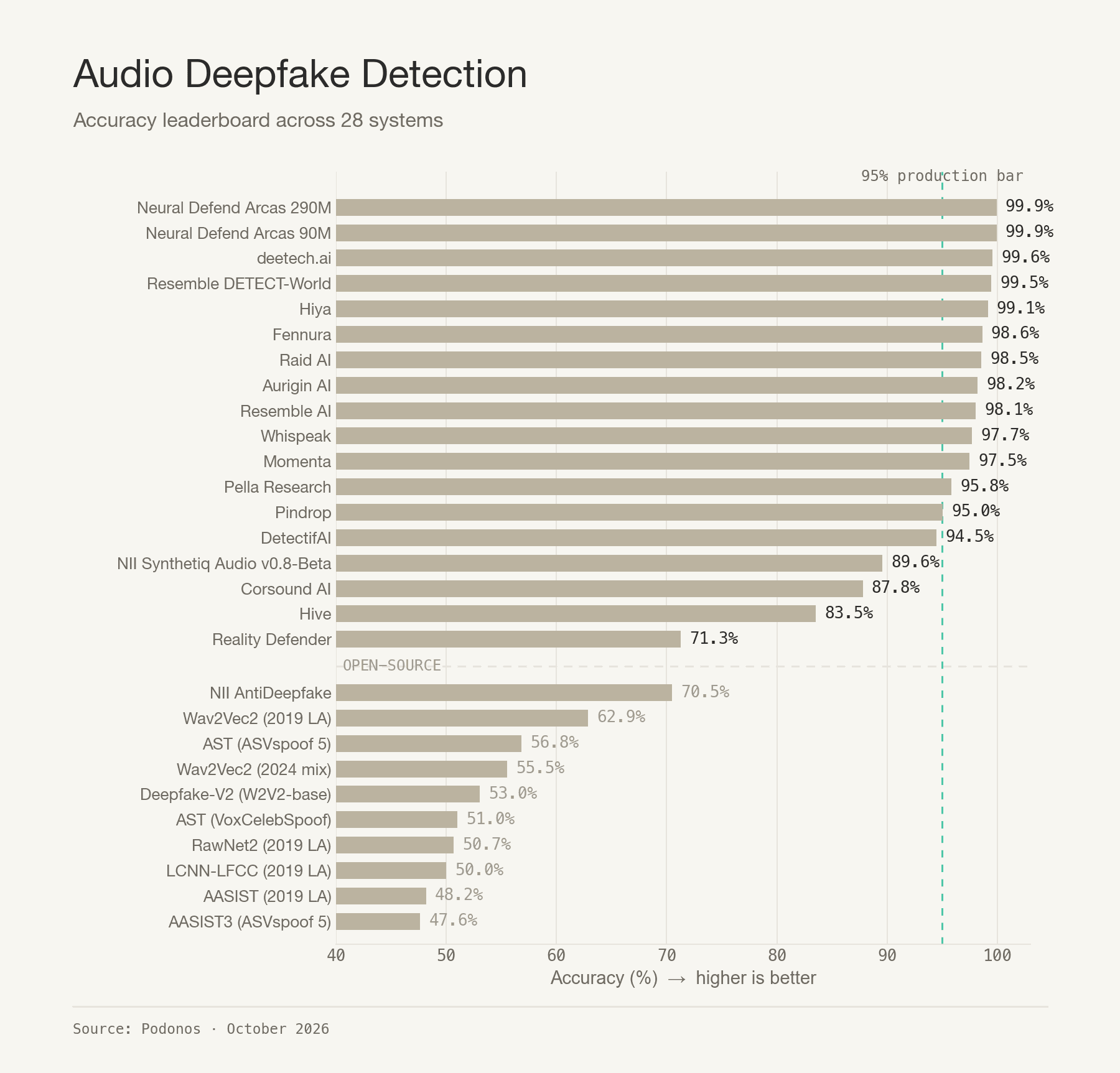
Audio deepfake detection benchmark: Neural Defend leads as 13 systems clear 95%

Five new entries later, our audio deepfake detection benchmark has 28 systems, Neural Defend leads at 99.93%, and 13 systems now clear 95% accuracy.

|7 min read

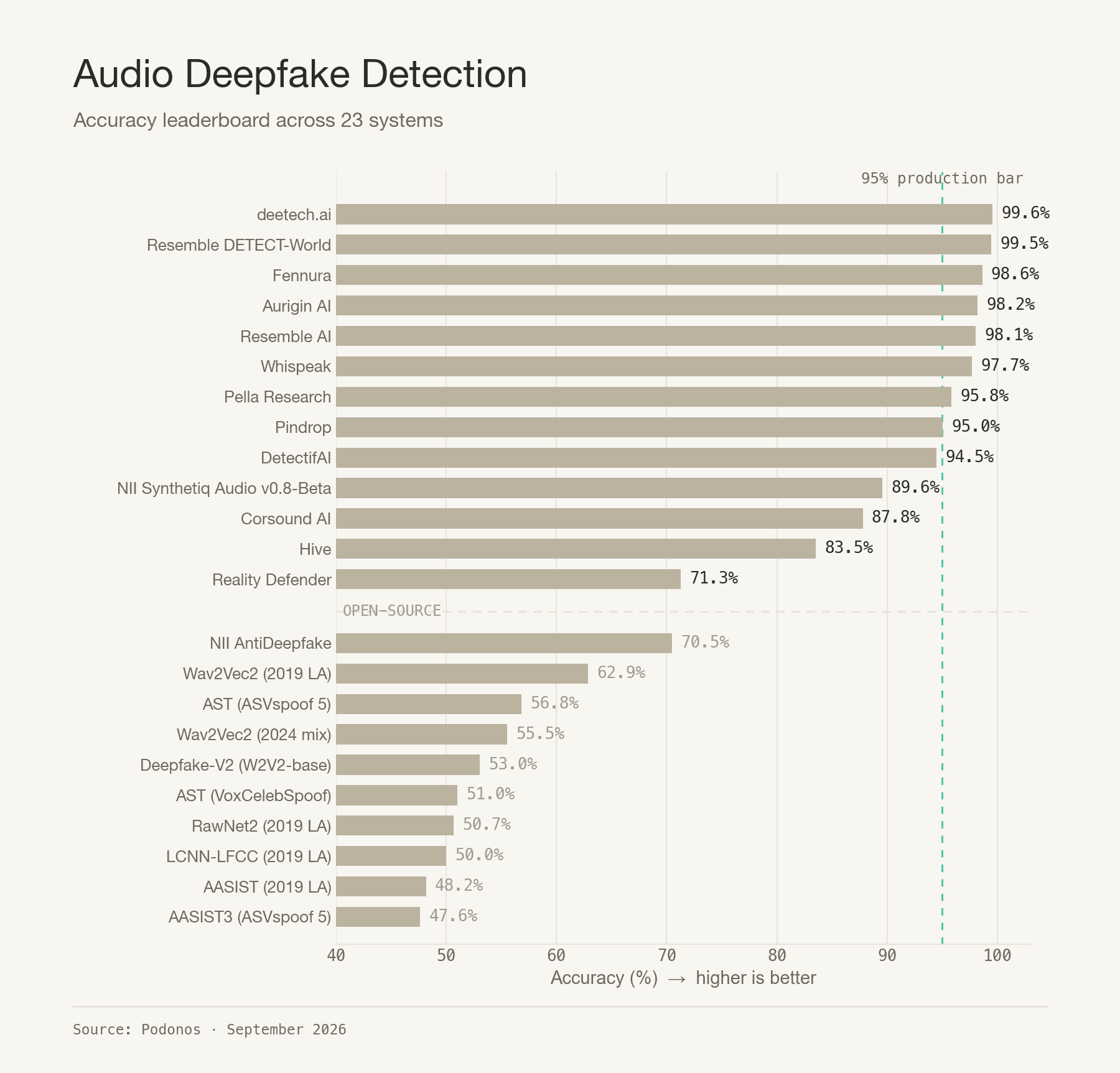
Audio deepfake detection benchmark: deetech.ai takes the top spot

Five new systems later, our audio deepfake detection benchmark has grown to 23 entries, and eight systems now clear 95% accuracy.

|11 min read

Audio deepfake detection benchmark: an open model finally clears the production bar

When we last published this benchmark, four commercial systems sat above 95% accuracy and none of nine downloadable open-source models scored above 63%.

|10 min read

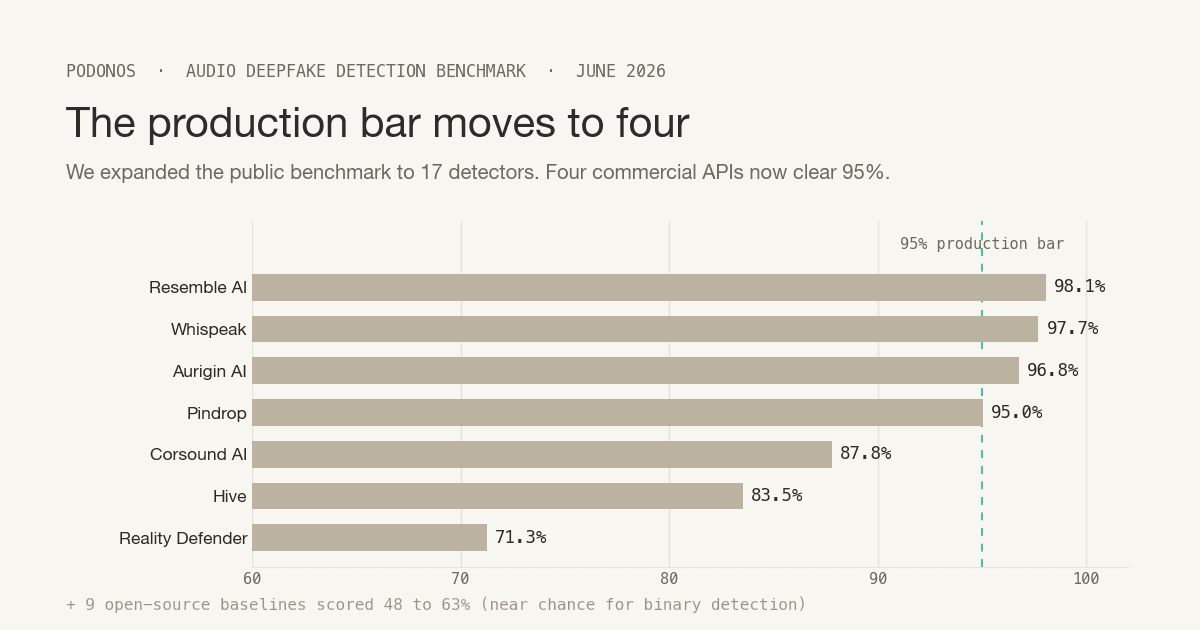
Audio Deepfake Detection Benchmark: the production bar moves to four

Nine new systems later, the top of our audio deepfake detection benchmark is crowded, the open-source gap is wider than ever, and speed sets systems apart.

|7 min read

Natural ≠ Preferred: What Our TTS Rankings Revealed About How Humans Actually Judge AI Voices

Naturalness and preference diverge: our US English TTS benchmark ranked Deepgram Aura 2 #1 for naturalness and Rime Arcana v3 #1 for preference.

|7 min read

Automatic Deepfake Audio Detection Benchmark

Every audio deepfake vendor reports accuracy around 99%, but none of those numbers are comparable: each comes from a test set the vendor controls.

|7 min read

Announcing the Selected Teams for the Podonos Research Support Program

After meeting speech and audio researchers and reviewing their applications, we announce the teams selected for the Podonos Research Support Program.

|2 min read

Benchmarking Chatterbox Turbo: How Resemble AI Evaluated Open-Source Voice AI with Podonos

Resemble AI's open-source Chatterbox showed open TTS models are viable alternatives to proprietary systems. Chatterbox Turbo takes that a step further.

|5 min read

Introducing Podonos Flash

Human evaluation gives voice AI teams the best insight but takes time, and fast AI evaluators often miss human perception. Podonos Flash changes that.

|4 min read

Podonos just raised $2.4M in pre-seed funding

Podonos has raised $2.4M in pre-seed funding to tackle voice AI evaluation, led by Serac Ventures with participation from Naver D2SF and KAIST Ventures.

|3 min read

Ready to unlockthe potential ofyour Voice AI Model?

Improve your model with trust