AI Evaluation Built on Human Expertise.
In voice AI research, teams rely heavily on evaluation to understand how a model is performing and where it needs improvement. Human evaluation delivers the highest quality insight, but it takes time and requires coordination.
Many AI-based evaluators are fast, but they often fail to match human perception closely enough to support confident decisions.
Podonos Flash changes that.
Flash is an AI evaluation engine trained on Podonos' refined and high-quality human evaluation data.
This foundation gives Flash the speed of an automated system and the consistency of human judgment.
Why Flash Delivers Higher Quality
Flash is designed to replicate human evaluation patterns as closely as possible.
Its training data consists entirely of carefully validated human judgments collected by Podonos across naturalness, similarity, noise conditions, and other attributes that matter in voice AI quality.
Because Flash learns from real human preferences, it produces scoring behavior that aligns strongly with ground-truth human evaluation.
Across key metrics such as naturalness and noise, Flash shows significantly higher Spearman correlation with human results compared to other available models.
This difference is not theoretical. It directly improves the reliability of quality checks, regression detection, and model comparison.
A Faster Path to High-quality Voice AI Models
Fast and trustworthy evaluation enables faster iteration.
With Flash, teams can:
- Evaluate thousands of audio samples in seconds
- Compare model versions without waiting for human review cycles
- Detect regressions early and frequently
- Validate model changes before training large-scale versions
- Screen datasets quickly to maintain data quality
Faster iteration leads to better models, and Flash provides the speed that modern development cycles require.
Powered by Podonos Human Evaluation Data
The performance of any AI evaluator depends entirely on the quality of its training data.
Flash is built on a large body of high-quality human evaluation samples that Podonos has collected over time running rigorous assessments.
These samples are standardized, quality-checked, and diverse enough to represent the wide range of conditions found in real-world audio.
This data foundation is what allows Flash to outperform traditional evaluation models.
The insights it produces are not generic. They reflect patterns observed in actual human perception.
Better data results in better evaluation. Flash exists because Podonos has invested deeply in human evaluation since day one.
Flash Performance Metrics
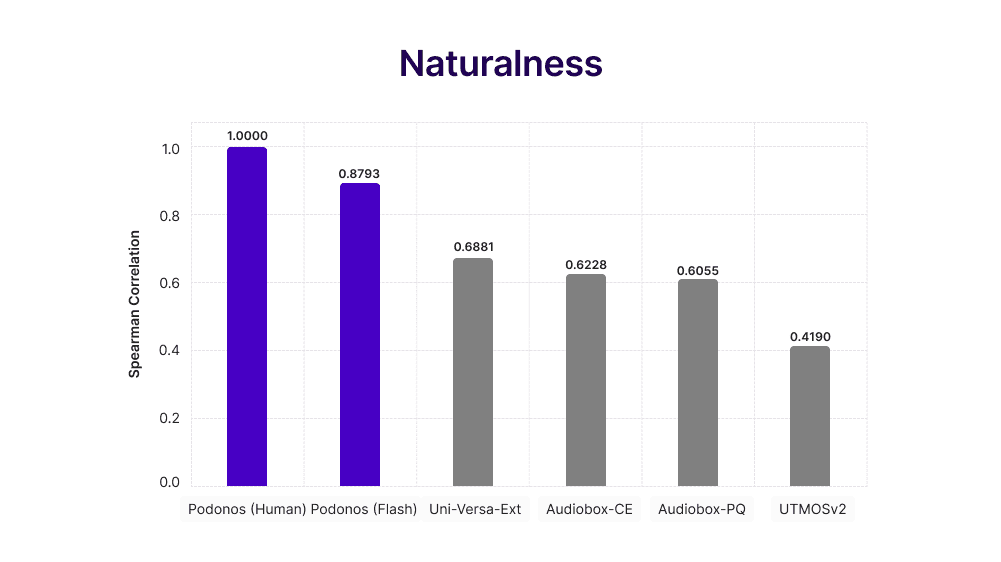
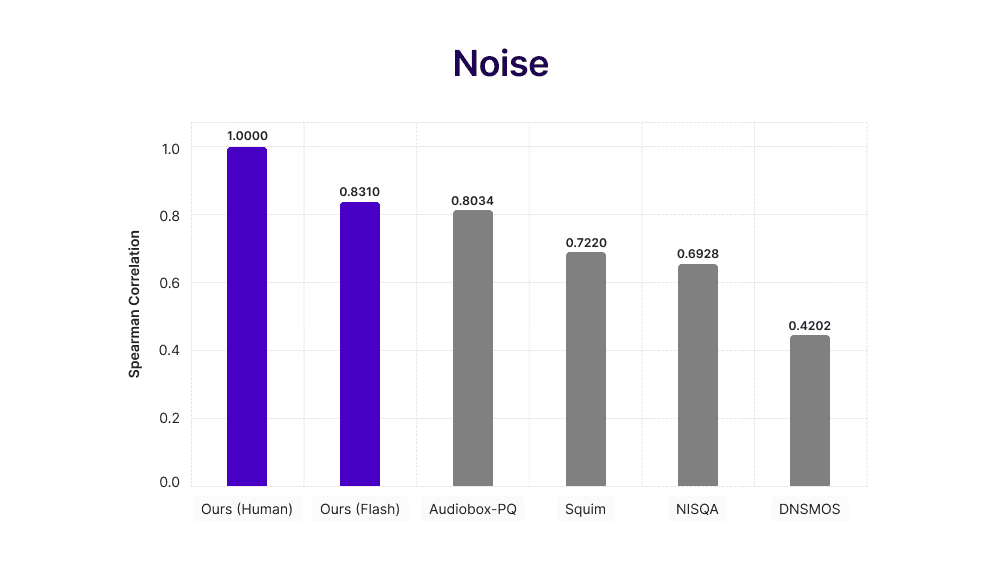
Flash consistently outperforms other evaluation models in correlation with real human judgment.
These results demonstrate why Flash is a perfect choice for rapid and large-scale evaluation.
Also, you can listen to a few samples in the table below. If the values for each model are close to the groundtruth obtained from a large-scale human evaluation, it is better.
Podonos vs. Other Models : Naturalness
Podonos Human
Podonos Flash
Uni-Versa-Ext
Audiobox- CE
Audiobox- PQ
UTMOSv2
1.00
1.14
1.90
1.93
2.29
2.39
2.00
2.70
4.11
3.12
3.77
3.26
4.57
4.29
4.61
3.51
4.00
2.73
Podonos vs. Other Models : Noise Quality
Podonos Human
Podonos Flash
Audiobox- PQ
Squim
NISQA
DNSMOS
1.33
1.29
2.84
2.58
4.24
3.90
2.67
2.80
2.64
4.09
4.02
4.02
3.17
3.29
3.65
4.26
4.26
4.01
In both utterance naturalness and noise quality evaluation, Flash demonstrates the superior performance compared to existing models.
Launching January 2026
Podonos Flash will be fully available to all users in January 2026.
Flash introduces a fast and scalable AI evaluation option that reflects real human perception and supports rapid model development.
It is designed to help teams iterate quickly, assess quality with confidence, and improve the overall performance of their voice AI systems.
Stay tuned!
You can’t wait? Please contact hello@podonos.com