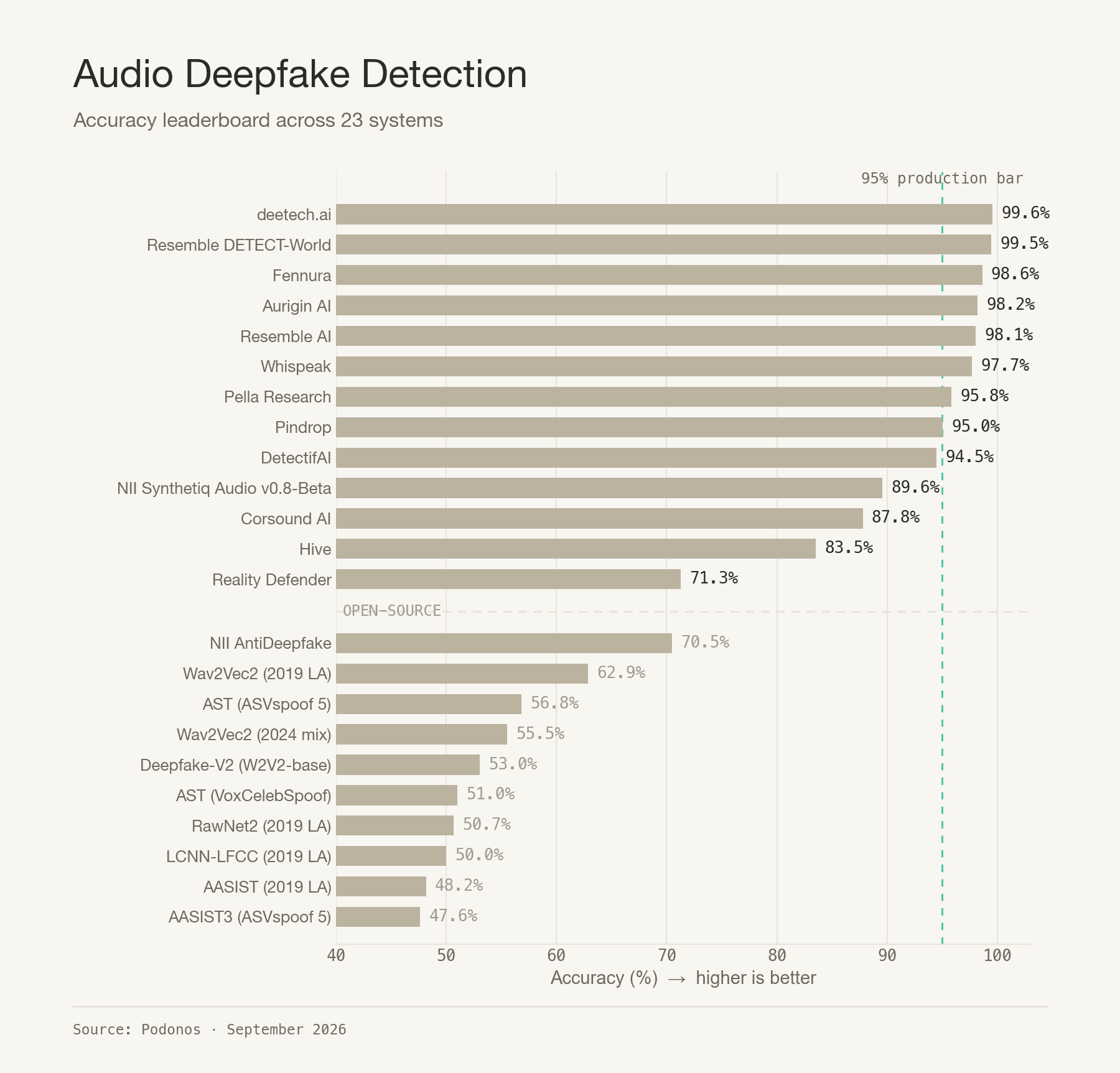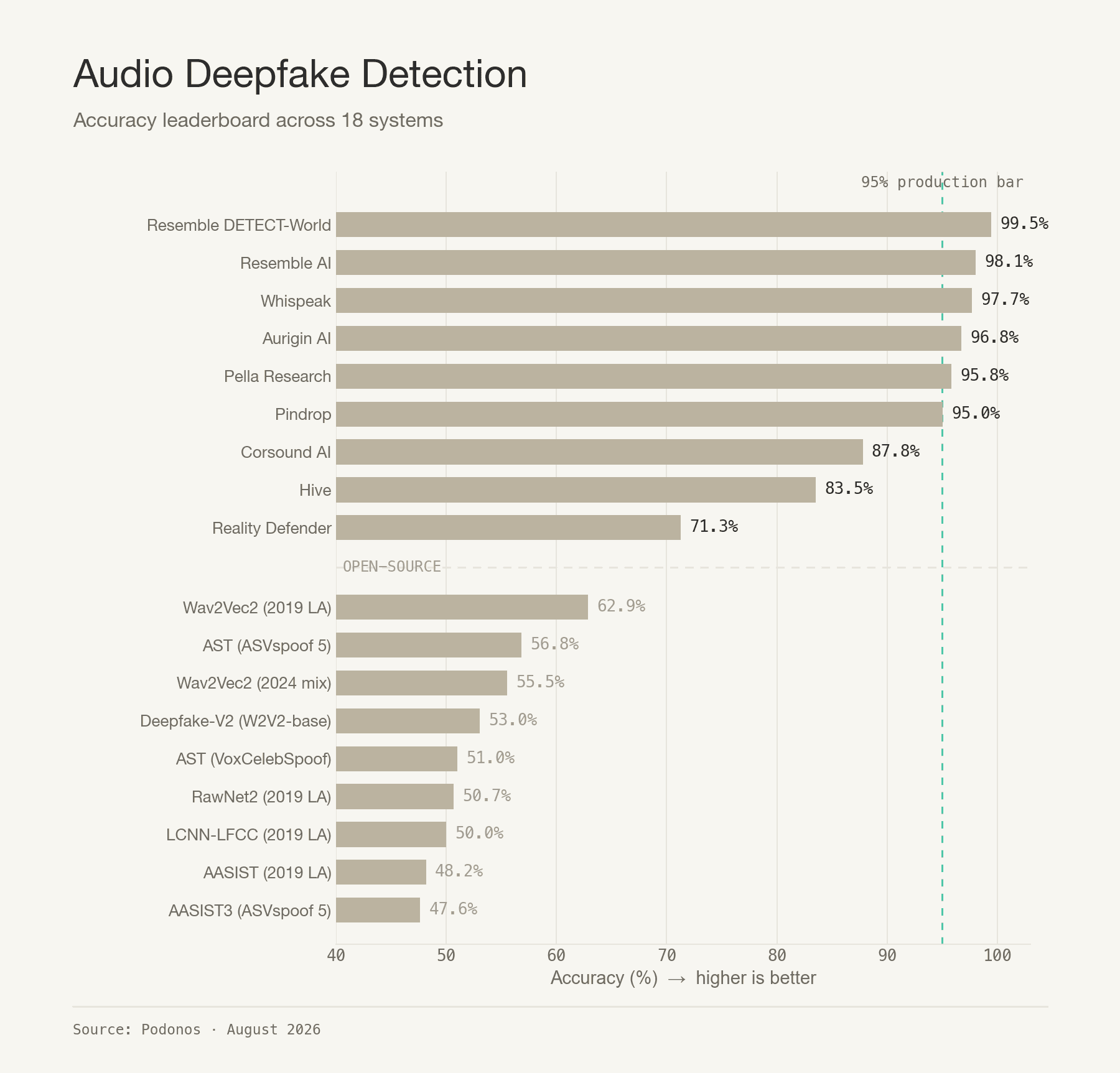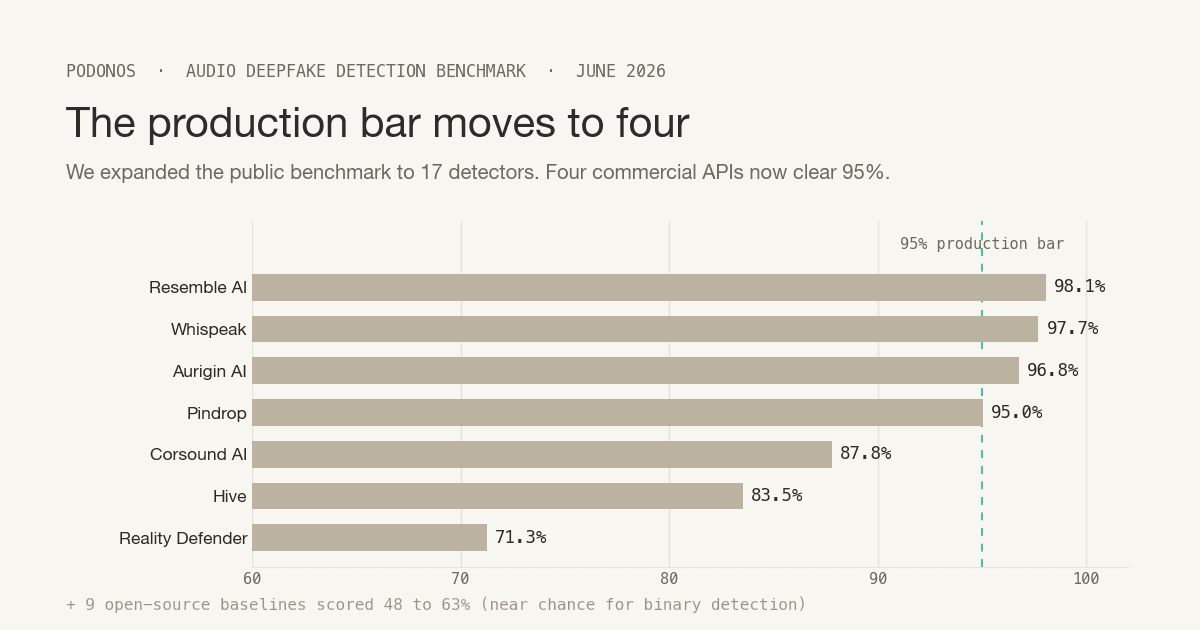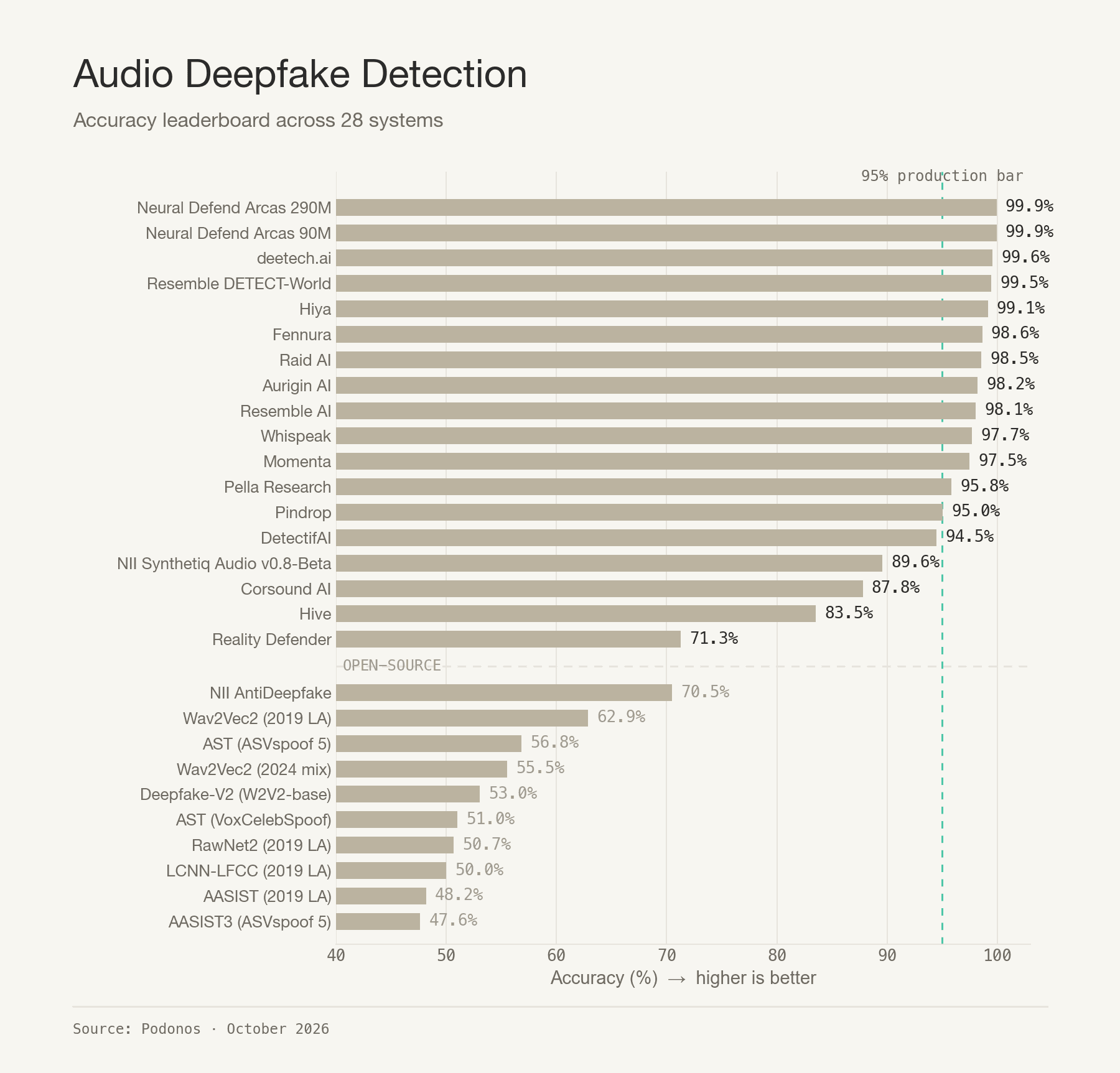
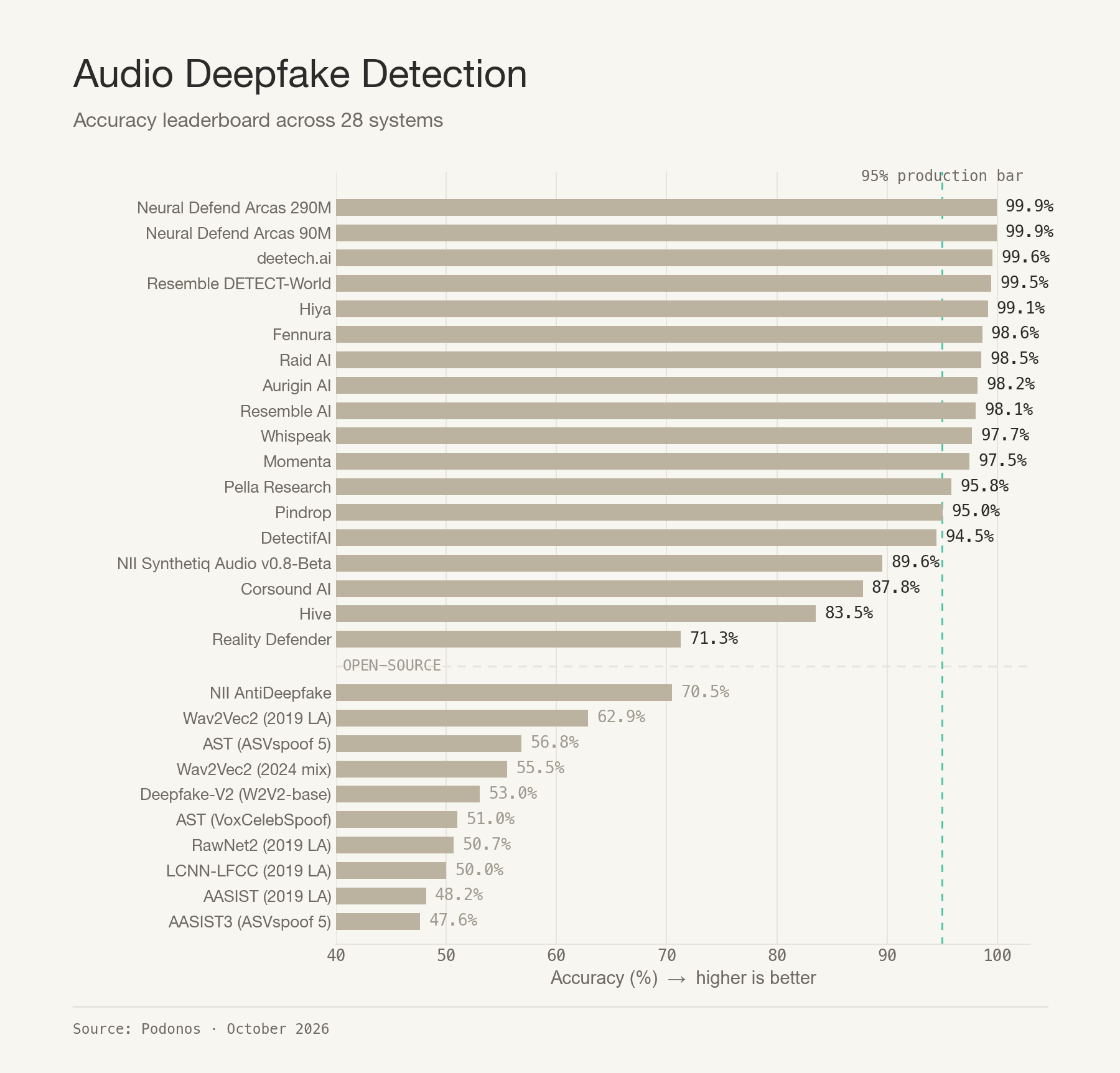
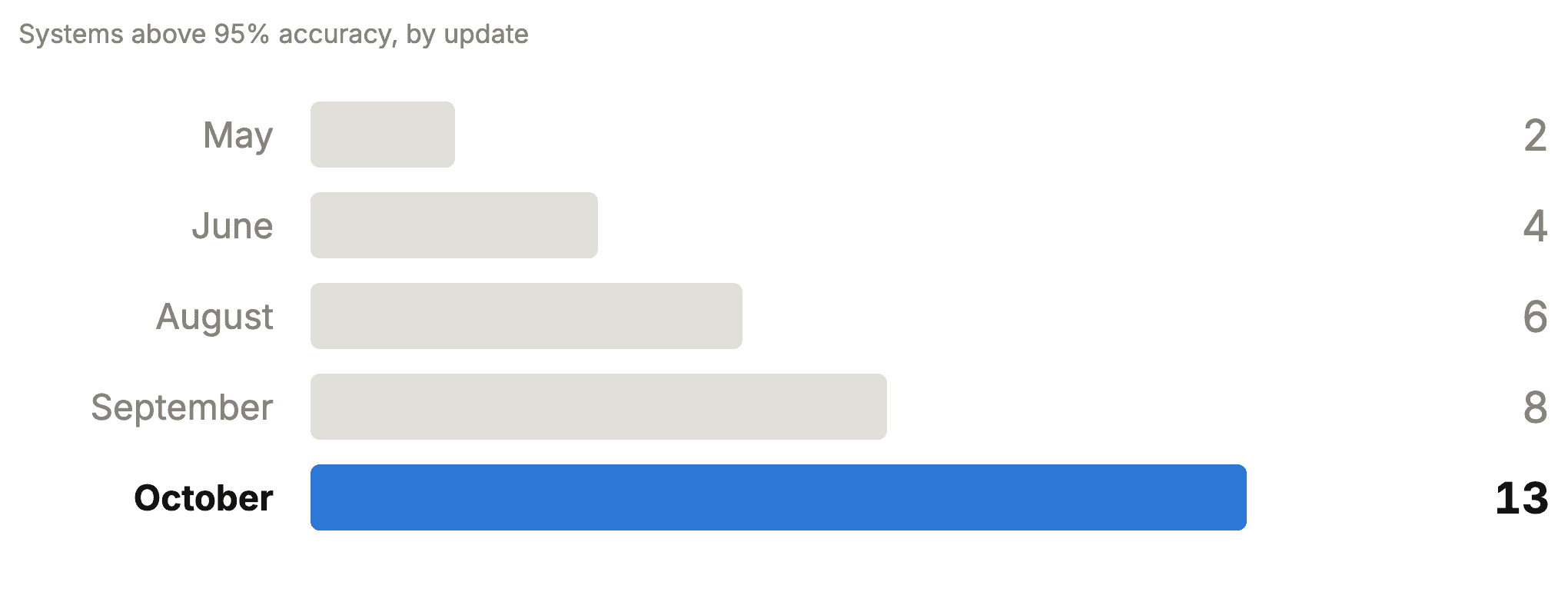
In September, eight systems cleared 95% accuracy on this benchmark and deetech.ai took first place. Five new entries later, the board has grown to 28 systems: 18 commercial entries from 16 vendors, and 11 systems whose weights you can download (Pella Research counts in both groups). Thirteen systems now clear 95%.
Four results stand out in this update:
- A new leader. Neural Defend enters with two models, Arcas 290M and Arcas 90M, which tie for first at 99.93%: three errors each in 4,524 files.
- Every newcomer lands above 97%. Hiya (99.14%), Raid AI (98.54%) and Momenta (97.46%) all enter inside the top eleven.
- The fast end gets crowded. Hiya (31 ms) and Momenta (42 ms) join DetectifAI under 50 ms per file, and both pair that speed with accuracy above 97%.
- New, stricter submission rules. One model per vendor per month, timing data required, and every vendor sees its result before deciding whether to publish it.
The ground rules have not changed. Vendors routinely self-report around 99% accuracy on their own test sets, and those numbers are not comparable to each other. We hold a fixed set of 4,524 clips with private gold-standard labels and compute every row's metrics ourselves, the same way, on the same files.
The leaderboard
 #  System                           Acc%     F1   FPR%  FNR%  Lat(ms)     RTF
--  ------------------------------  -----  -----  -----  ----  -------  ------
 1  Neural Defend Arcas 290M*       99.93  0.999    0.1   0.0      118   0.041
 2  Neural Defend Arcas 90M*        99.93  0.999    0.1   0.0       89   0.030
 3  deetech.ai                      99.56  0.996    0.4   0.4       50   0.019
 4  Resemble DETECT-World           99.47  0.995    0.7   0.4      399    0.12
 5  Hiya*                           99.14  0.991    0.5   1.2       31   0.011
 6  Fennura                         98.63  0.986    1.2   1.5      553    0.14
 7  Raid AI*                        98.54  0.985    1.9   1.0       93   0.033
 8  Aurigin AI                      98.21  0.982    2.4   1.1      n/a     n/a
 9  Resemble AI (DETECT-3B Omni)    98.05  0.981    2.5   1.4    1,164    0.40
10  Whispeak                        97.70  0.977    2.9   1.7    1,052    0.39
11  Momenta*                        97.46  0.975    2.3   2.8       42   0.011
12  Pella Research (pellav2)        95.82  0.959    5.5   2.8       57   0.021
13  Pindrop                         95.05  0.951    6.2   3.7      282   0.076
14  DetectifAI                      94.47  0.946    8.4   2.7       24  0.0084
15  NII Synthetiq Audio v0.8-Beta   89.57  0.892    6.6  14.2       91   0.024
16  Corsound AI                     87.79  0.865    1.0  23.1      180   0.035
17  Hive                            83.53  0.808    2.4  30.5      881    0.34
18  Reality Defender                71.27  0.770   53.7   3.6    5,718    1.52
19  NII AntiDeepfake                70.47  0.584    0.4  58.6       91   0.024
20  Wav2Vec2 (2019 LA)              62.89  0.514   13.4  60.8      622    0.14
21  AST (ASVspoof 5)                56.83  0.657   69.0  17.4        5  0.0017
22  Wav2Vec2 (2024 mix)             55.55  0.499   33.1  55.8      219   0.056
23  Deepfake-V2 (W2V2-base)         53.03  0.162    3.1  90.9       94   0.027
24  AST (VoxCelebSpoof)             50.99  0.048    0.5  97.5        8  0.0030
25  RawNet2 (2019 LA)               50.66  0.430   35.9  62.7       94   0.035
26  LCNN-LFCC (2019 LA)             50.00  0.667  100.0   0.0       23  0.0056
27  AASIST (2019 LA)                48.17  0.486   52.6  51.1      322    0.11
28  AASIST3 (ASVspoof 5)            47.63  0.029    6.3  98.4      363    0.13
Rows 1–18 are commercial; rows 19–28 are open-source baselines. * new in this update. N is 4,524 for every system except Hiya (4,420), Corsound (3,875) and Reality Defender (3,745), which decline some short clips, so those three rows are scored on a subset and are not directly comparable to full-coverage rows. Pella Research and NII AntiDeepfake publish downloadable weights. Resemble AI (DETECT-3B Omni), Hive and Reality Defender were run by Podonos against the vendor's API, with latency measured by us; every other commercial latency is self-reported. Aurigin AI's row replaced an earlier result at the vendor's request and carries no timing data. RTF is the mean of per-file latency divided by duration, so short clips weigh heavily.
What changed since September
- Five new entries from four vendors: Neural Defend (Arcas 290M and Arcas 90M, tied for first), Hiya (#5), Raid AI (#7) and Momenta (#11).
- Thirteen systems now clear 95%, up from eight in September. The bar has been crossed by more systems in every update since we launched.
- New submission rules that make every row a single, opt-in, fully timed submission.
A new leader: Neural Defend
Neural Defend submitted two sizes of its Arcas detector, and both land at 99.93%. Each made three errors across 4,524 files. The false positive rate is 0.1%, and the false negative rate rounds to 0.0%. That is the closest any system has come to a clean sweep of this set.
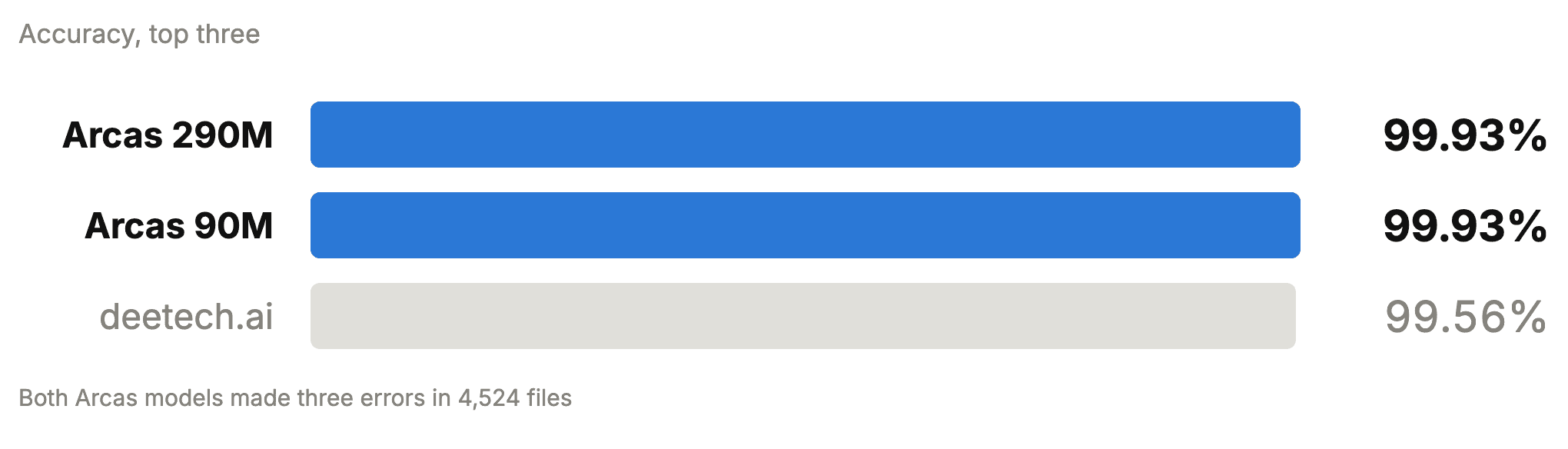
The two models differ in size, not in result. Arcas 290M reports 118 ms per file and Arcas 90M reports 89 ms, so the smaller model gives up nothing on accuracy here while running about a quarter faster. If you are choosing between them, this benchmark gives you no reason to pay for the larger one.
The lead is real but narrow. deetech.ai, last month's leader, holds at 99.56% with both error rates at 0.4%, and Resemble DETECT-World sits at 99.47%. On 4,524 clips, the gap from first to third is about 17 files. All four of these systems are a strong choice on accuracy alone; latency, integration and price will separate them in practice.
Three more debuts, all above 97%
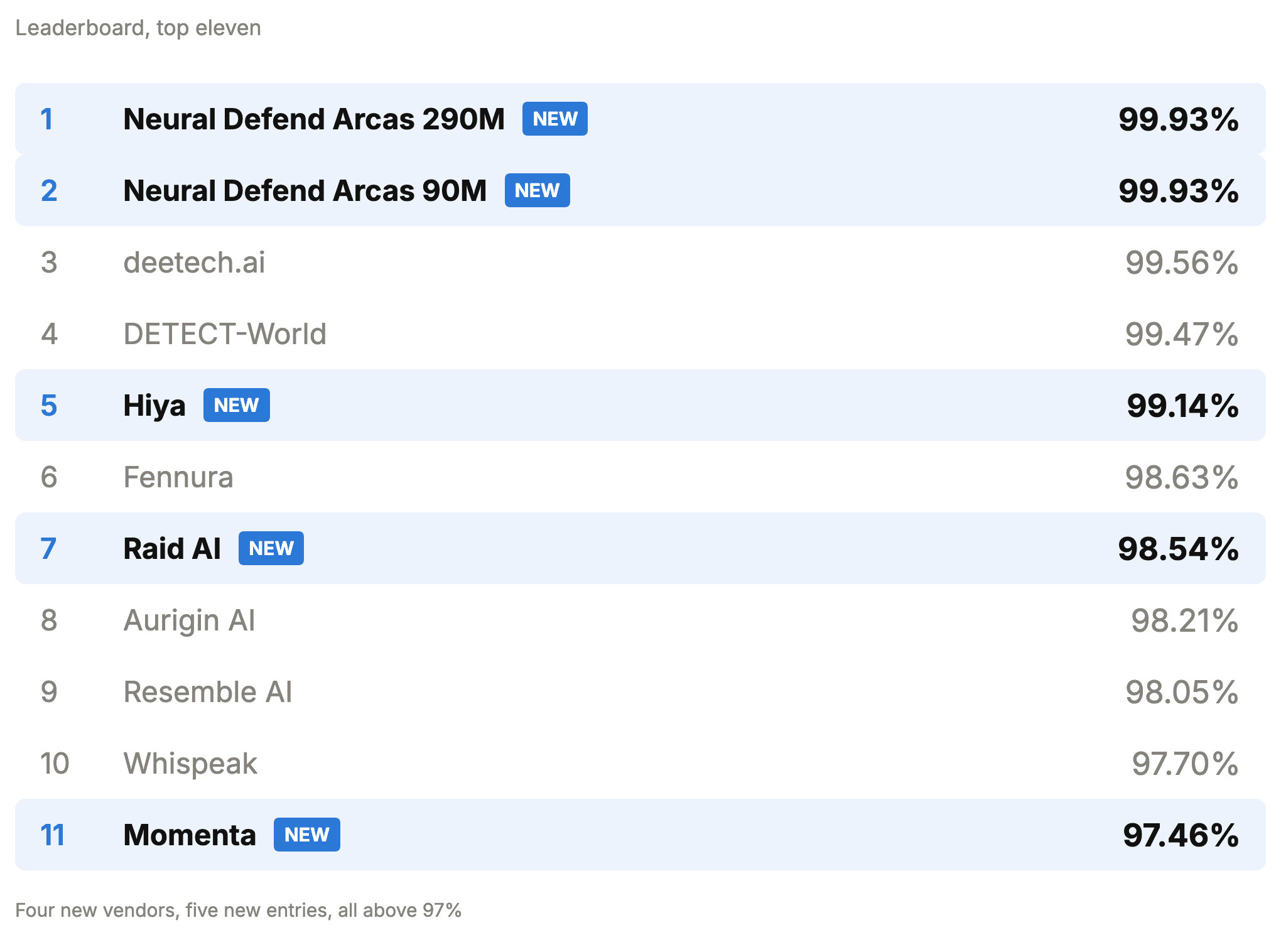
The newcomers did not just make the board, they landed near the top of it.
- Hiya (99.14%) enters fifth with a 0.5% false positive rate and 1.2% false negative rate. It declined 2.3% of files, mostly very short clips, so its row is scored on 4,420 files rather than the full set. Re-scoring full-coverage systems on the subsets that partial-coverage systems accepted moves them by between −1.2 and +4.2 points, so read the gap to its neighbours with that in mind.
- Raid AI (98.54%) enters seventh, just behind Fennura. It leans slightly toward catching fakes, at 1.9% FPR against 1.0% FNR.
- Momenta (97.46%) enters eleventh with an even error profile, 2.3% FPR and 2.8% FNR, and one of the fastest reported times on the board.
The fast end gets crowded
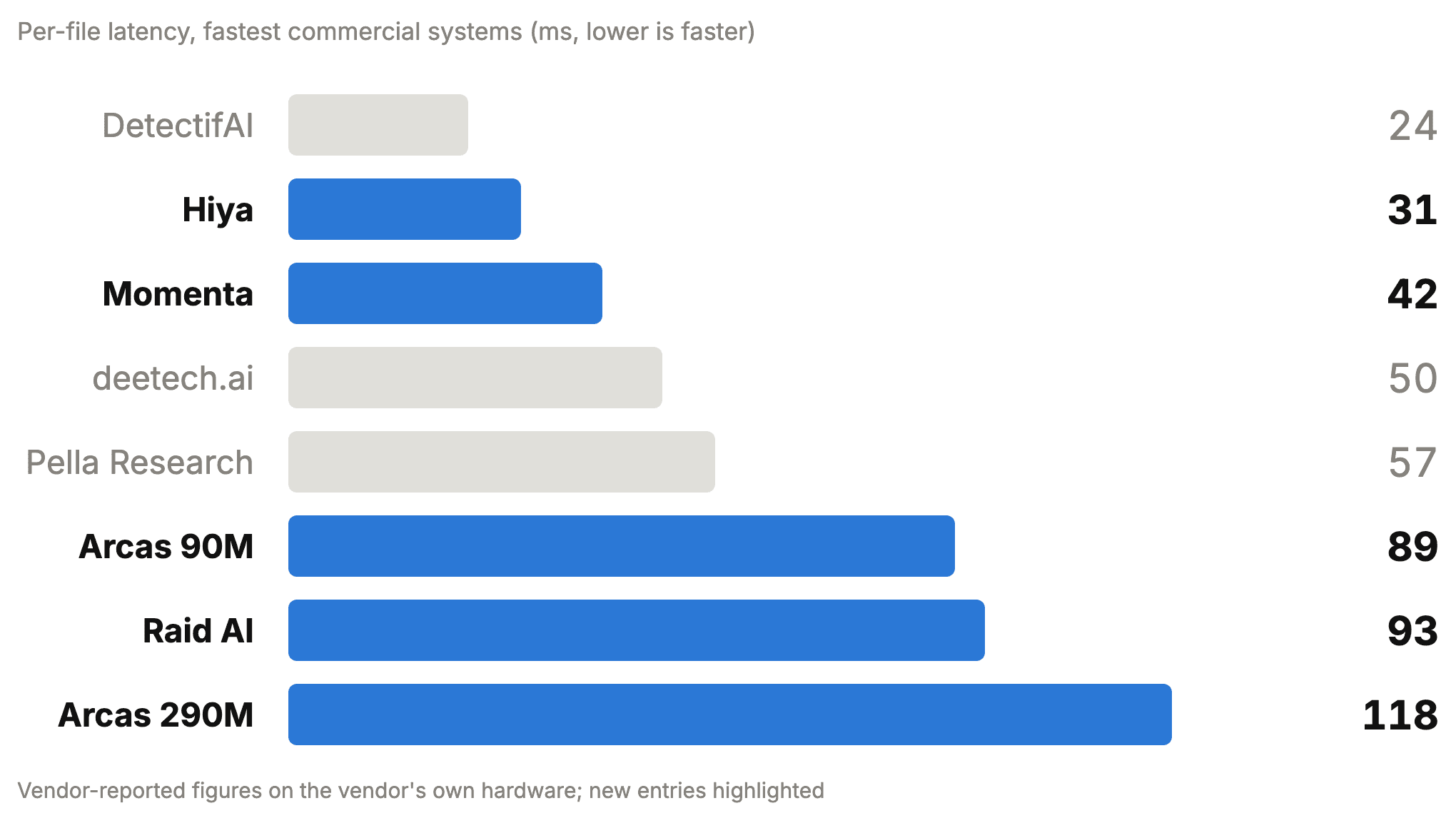
In September, DetectifAI stood alone as the fastest commercial detector at about 24 ms per file, with an accuracy just under 95%. It is still the fastest, but it now has company that does not trade away accuracy. Hiya reports 31 ms at 99.14%, and Momenta reports 42 ms at 97.46%, both with a real-time factor of 0.011. For live call scoring and high-volume queues, there are now several systems that are both fast and production-grade.
At the top, both Arcas models report under 120 ms, and Raid AI reports 93 ms. Six of the thirteen systems above 95% report under 100 ms per file.
As with every commercial latency figure outside the three systems we ran ourselves, these are self-reported on the vendor's own hardware (more on that below).
Thirteen systems now clear 95%

Alongside the leaders and newcomers above, the 95% group still includes Fennura (98.63%), which describes its detector as running on CPU alone, Aurigin AI (98.21%), Resemble AI's DETECT-3B Omni (98.05%), Whispeak (97.70%), Pella Research's pellav2 (95.82%) and Pindrop (95.05%), all unchanged since September.
Pella Research's pellav2 is still the best model on the board that you can download and run yourself, and still the only open-weights system above 95%. It leads the next open model, NII AntiDeepfake (70.47%), by 25.4 points. Nothing above it on the main board publishes weights, so if you need a model you can inspect, audit or run in your own environment, pellav2 remains the practical choice. The weights are on Hugging Face under an MIT licence.
The nine legacy open-source checkpoints still land between 47.6% and 62.9%. As in earlier updates, the lesson is that stale training data is the problem, not open weights.
The real choice is still an error trade-off
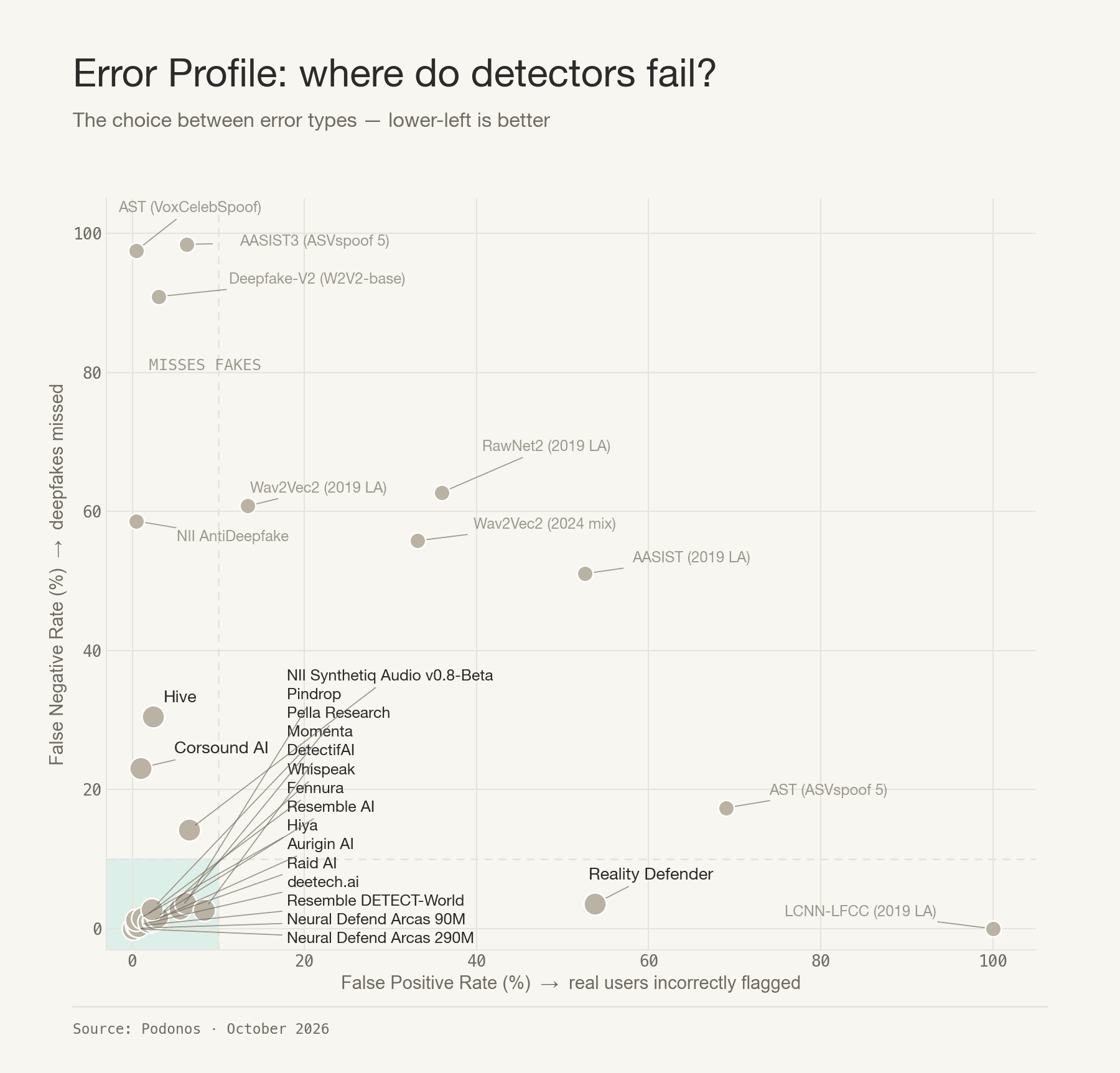
With thirteen systems above 95%, headline accuracy stops separating them. What separates them is which mistake you are buying. A false positive blocks a real customer or takes down legitimate content. A false negative lets a cloned voice through your KYC flow.
- Both errors matter roughly equally: Neural Defend's Arcas models (0.1% / 0.0%), deetech.ai (0.4% / 0.4%) and DETECT-World (0.7% / 0.4%).
- Missed fakes are the expensive error: Raid AI (1.0% FNR), Aurigin AI (1.1%) and Hiya (1.2%) sit just behind the top four.
- False alarms are the expensive error: within the 95% group, Hiya's 0.5% FPR is the lowest outside the top four. Below the 95% group, Corsound AI (1.0% FPR) and Hive (2.4% FPR) rarely false-flag, but miss 23.1% and 30.5% of the fakes they score.
- You need to run it yourself: pellav2, accepting a 5.5% false positive rate.
Reality Defender remains the outlier in the other direction. It false-flags 53.7% of the real audio it accepted, which is 1,009 of 1,878 clips, and declined a further 384 real clips.
Speed, with the same caveat
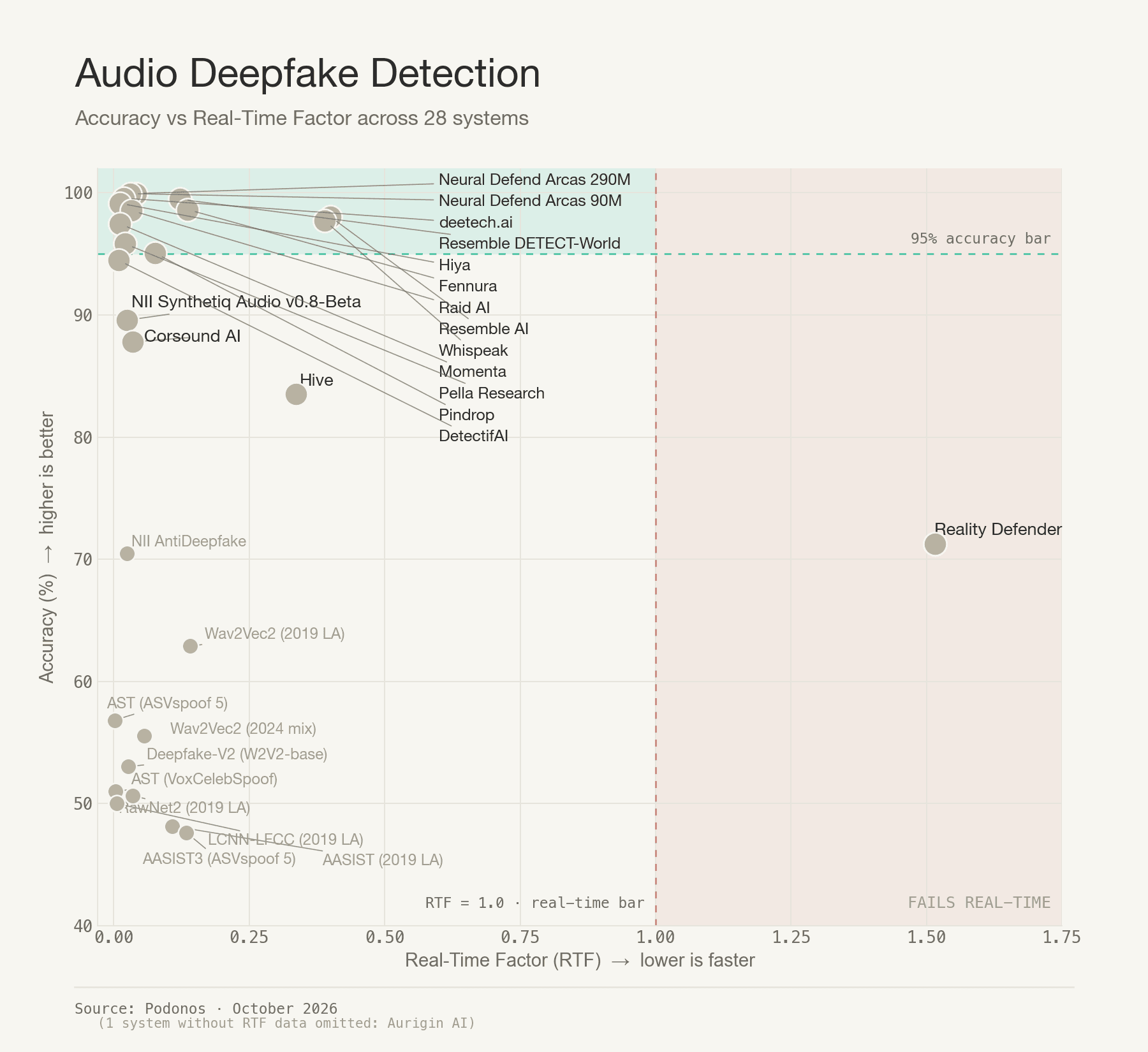
The latency columns are not verified the way the accuracy columns are. They mix three regimes: the three systems we ran ourselves (Resemble AI DETECT-3B Omni, Hive and Reality Defender) were run against the vendor's API and include network round-trip, other commercial rows are the vendor's own figures on the vendor's own hardware, and the open-source baselines were run locally by us. Treat them as indicative and do not read small gaps as meaningful.
Of the 27 systems with timing data, Reality Defender is the only one with an RTF above 1.0 (1.52). Aurigin AI submitted no timing data and is not on this chart. Pella's latency does not scale with clip length, which suggests a fixed-length analysis window rather than a full-file read, so its RTF is not comparable to systems that read the whole clip.
What we verify, and what we do not
- What we guarantee: we hold the gold labels privately and compute Accuracy, F1, FPR and FNR ourselves for every row. No vendor scores its own row, and the arithmetic behind every number is ours.
- What we cannot check: how a submitted predictions.csv was produced. Outside the three systems we ran ourselves (Resemble AI DETECT-3B Omni, Hive and Reality Defender), we did not run the system, so the labels in the file are taken on trust. All five new entries in this update are vendor submissions.
Limitations
The benchmark is English-only, and it is a snapshot of a fast-moving synthesis landscape. The latency and RTF columns mix measurement regimes. Rows with a non-zero rejection rate are scored only on the files they accepted. Vendor-submitted rows rely on the vendor running its system honestly over the set. And a single accuracy number on a fixed set is the start of a procurement decision, not the end of one. The dataset, scoring script, submission rules and telephony tracks are all in the benchmark repository.